Risk Management Training
Amongst others we do offer following risk management trainings:
| Training | Risk-management angle |
|---|---|
| ISO 27005 Risk Manager | Information security risk management framework based on ISO 27005. |
| PECB ISO 27005 Lead Risk Manager | Establishing, managing, and improving an information security risk management program based on ISO/IEC 27005:2022. |
| PECB ISO 27005 Foundation | Fundamental concepts and principles of information security risk management based on ISO 27005. |
| PECB ISO 31000 Risk Manager | Integrating ISO 31000 risk management guidelines into an organization. |
| PECB ISO 31000 Lead Risk Manager | Establishing, implementing, and maintaining a risk management framework and process based on ISO 31000. |
| PECB EBIOS Risk Manager | Information security risk assessment and risk management using the EBIOS method. |
Risk Management Training: Strengthen Cyber Resilience with NIS Institute
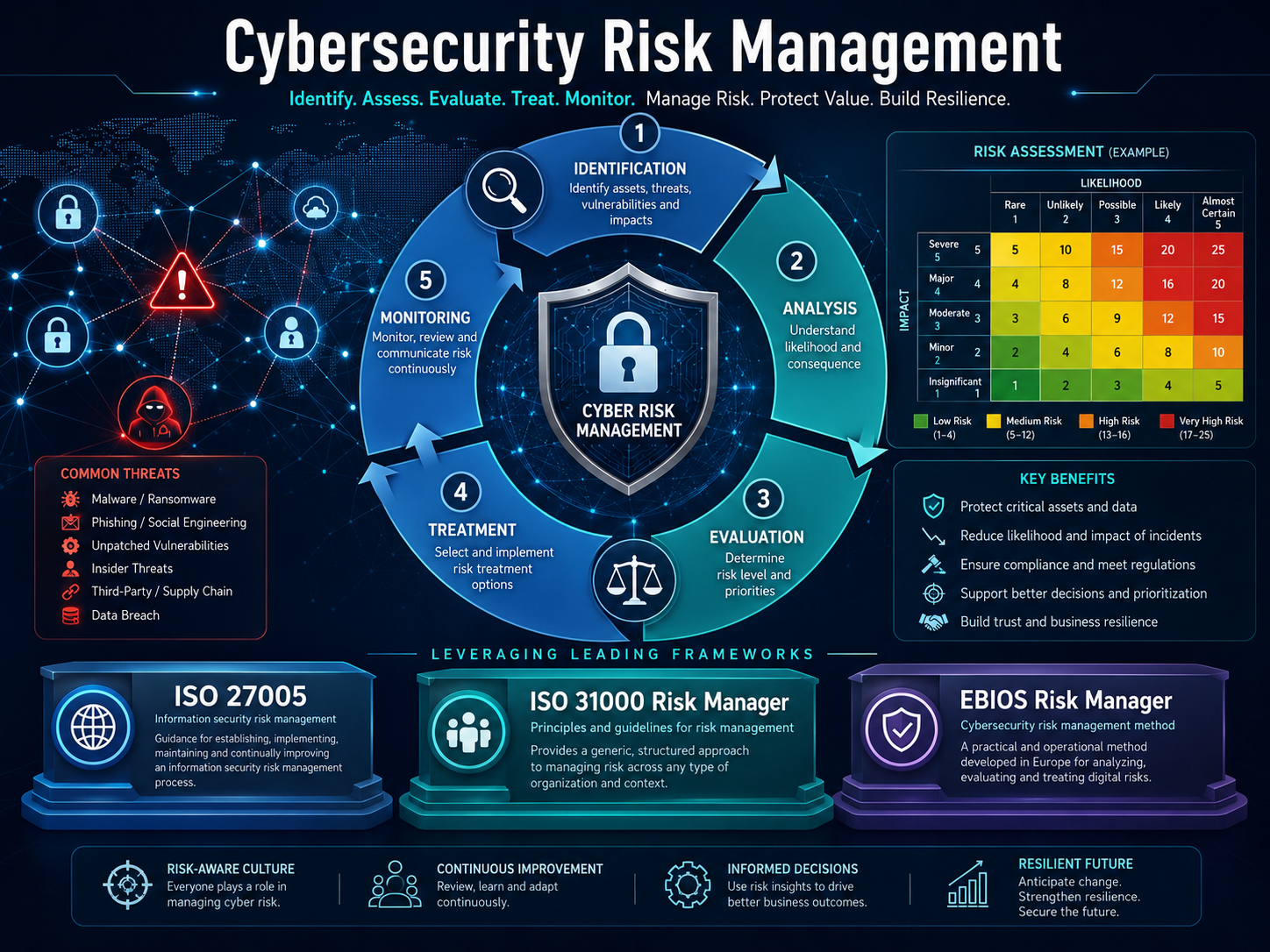
Risk management is at the heart of every mature cybersecurity, information security, and resilience program. Organizations cannot protect everything in the same way. They need to understand what matters most, identify threats and vulnerabilities, assess potential impacts, choose appropriate controls, and continuously monitor whether risks remain acceptable.
That is why NIS Institute offers several risk management trainings that help professionals move from ad hoc security decisions to structured, repeatable, and standards-based risk management.
Why risk management matters in cybersecurity
Cybersecurity is not only about technology. It is about making informed decisions. A strong risk management approach helps organizations identify what could go wrong, understand business impact, prioritize treatment actions, and support compliance with standards and regulations.
NIS Institute’s training catalog includes multiple courses that address this need, from information security risk management with ISO 27005, to enterprise-wide risk management with ISO 31000, and practical risk assessment using the EBIOS method.
ISO 27005: risk management for information security
For organizations working with information security management systems, ISO 27005 is one of the most relevant risk management standards.
The ISO 27005 Risk Manager training enables participants to understand the process of developing, establishing, maintaining, and improving an information security risk management framework based on ISO 27005.
For professionals who need a more advanced path, the PECB ISO 27005 Lead Risk Manager training focuses on the competencies required to assist organizations in establishing, managing, and improving an information security risk management program based on ISO/IEC 27005:2022.
This course also connects ISO 27005 with ISO 27001 and other risk management approaches such as OCTAVE, EBIOS, MEHARI, CRAMM, NIST, and Harmonized TRA. It is especially relevant for ISMS professionals, risk owners, information security teams, IT professionals, privacy officers, consultants, project managers, and professionals responsible for maintaining conformity with ISO/IEC 27001 requirements.
ISO 31000: risk management across the organization
Where ISO 27005 focuses on information security risk, ISO 31000 provides broader organizational risk management guidance.
The PECB ISO 31000 Risk Manager training helps participants acquire the knowledge and ability to integrate ISO 31000 risk management guidelines into an organization. It covers risk management principles, the risk management framework, the risk management process, and approaches for assessing risk in a wide range of situations.
The training objectives include understanding ISO 31000 risk management principles, establishing and improving a risk management framework, and applying the risk management process according to ISO 31000 guidelines.
NIS Institute also lists PECB ISO 31000 Lead Risk Manager, a training focused on a comprehensive understanding of the principles, framework, and process of risk management, including the practical aspects of establishing, implementing, and maintaining a risk management framework and process within an organization.
EBIOS Risk Manager: a practical method for information security risk assessment
The PECB EBIOS Risk Manager training is another important option for professionals who want a practical risk assessment method.
NIS Institute describes the course as a way to master risk management concepts and components related to all assets relevant for information security, based on the EBIOS method.
The training includes practical exercises and case studies, helping participants acquire the skills needed to perform information security risk assessments and timely risk management. NIS Institute also positions the training as fitting well within the ISO/IEC 27001 implementation process.
Learning objectives include understanding EBIOS risk management principles, carrying out EBIOS studies, managing security risks for information systems, and communicating the results of an EBIOS study.
Which risk management training should you choose?
Choose ISO 27005 Foundation if you want to understand the basic concepts of information security risk management.
Choose ISO 27005 Risk Manager or ISO 27005 Lead Risk Manager if your focus is cybersecurity, information security, ISO 27001, ISMS risk management, or information security risk treatment.
Choose ISO 31000 Risk Manager or ISO 31000 Lead Risk Manager if you need a broader organizational risk management approach that goes beyond information security.
Choose EBIOS Risk Manager if you want a practical, scenario-based method for information security risk assessment that can support ISO 27001 implementation.
Conclusion
Risk management training is essential for organizations that want to strengthen cyber resilience, improve decision-making, and align security investments with business priorities.
Through ISO 27005, ISO 31000, and EBIOS Risk Manager trainings, NIS Institute provides clear learning paths for professionals who need to understand, implement, manage, assess, and improve risk management practices. Whether your focus is information security, enterprise risk, ISO 27001 alignment, or practical risk assessment, these trainings help turn risk management from a compliance obligation into a practical capability.