SOC 2, ISAE 300 and ISAE 3402 vs ISO 27001
Choosing the Right Assurance Path for Your Organization
Introduction
As organizations grow and operate across borders, the need to demonstrate trust becomes just as important as building secure systems. At some point, every company faces the same question:
How do we prove to customers that our controls actually work?
For many organizations, the journey starts with ISO 27001, which is the international standard for information security, that can be certified (if you wish).
But once international organizations — especially with activity in the United States — enter the picture, new requirements quickly emerge. Terms like SOC 2, ISAE 3000 and ISAE 3402 start to appear, often creating confusion about what each framework actually means.
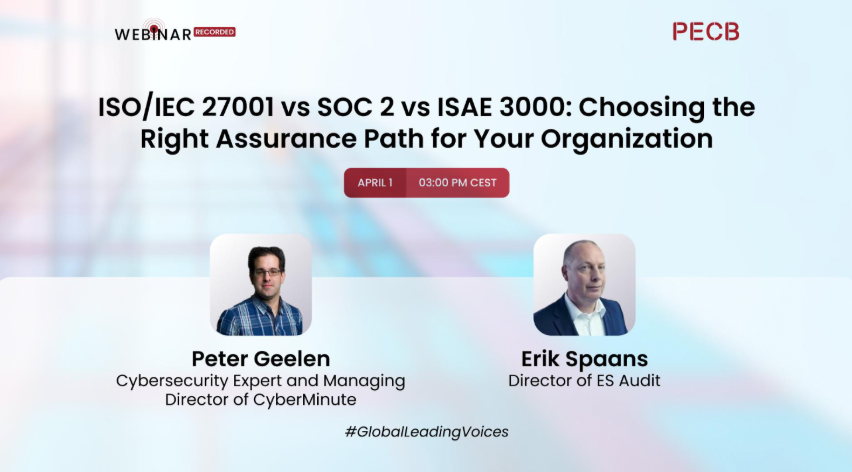
During a recent interview and webinar, Peter Geelen and Erik Spaans explored these differences in depth. What became clear is that these frameworks are not interchangeable — they serve fundamentally different purposes.
At the end of the article, you can jump to the published recording and the presentation deck.
From compliance to assurance
To understand the distinction between compliance an assurance, it helps to start with the concept of assurance itself.
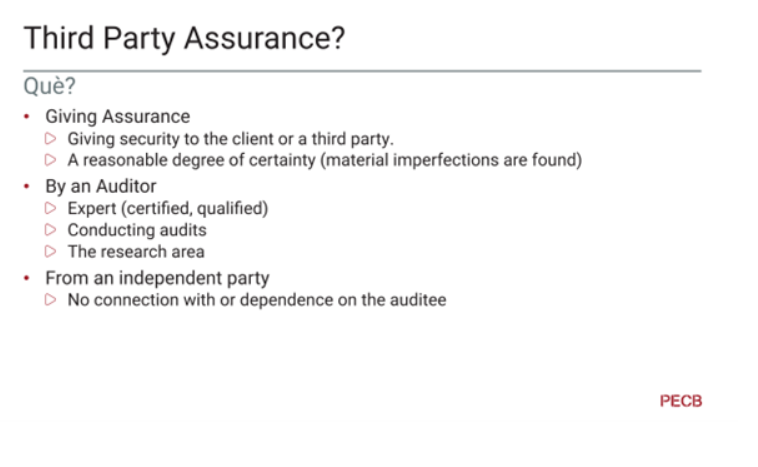
As highlighted in the webinar, assurance is about providing confidence to third parties through independent verification. It is not enough to say that controls (measures) exist; organizations must demonstrate that those controls are effective over time.
This is where the divide begins.
ISO 27001 focuses on building and improving security processes (PPPT, people, process, physical & technology controls), which is called a management system, focusing on internal operations.
Assurance frameworks such as SOC 2 and ISAE, on the other hand, are designed to evaluate and communicate how well services actually perform in practice, focus on external services.
ISO 27001: building a structured security foundation
ISO 27001 remains the cornerstone of information security for many European organizations. It’s strength lies in its structured approach. Built on the well-known Plan–Do–Check–Act (or adjust) steps, aka the PDCA cycle, it guides companies in setting up a complete Information Security Management System.
Rather than focusing on isolated controls, ISO 27001 looks at the organization or process as a whole. It combines governance, people, processes, technology, and even physical security into a single framework. As shown in the webinar slides, this structure is supported by a set of clauses and a set of detailed annex controls derived from ISO 27002.
The 93 controls are grouped into 15 functional groups (known as operational controls)
What makes ISO particularly powerful is its emphasis on continual improvement. Organizations are not expected to be perfect from day one. Instead, they are encouraged to build maturity over time, gradually strengthening their controls and processes.
As Peter explains in the webinar, this makes ISO 27001 an ideal starting point: it creates control, structure, and a roadmap for growth.
ISAE and SOC 2: proving performance to customers
While ISO 27001 focuses on company inward, assurance frameworks look outward.
ISO 27001 focusses on internal processes; ISAE and SOC 2 focus only on external services delivered to customers.
Frameworks such as SOC2, ISAE 3000 and ISAE 3402 originate from the world of accounting.
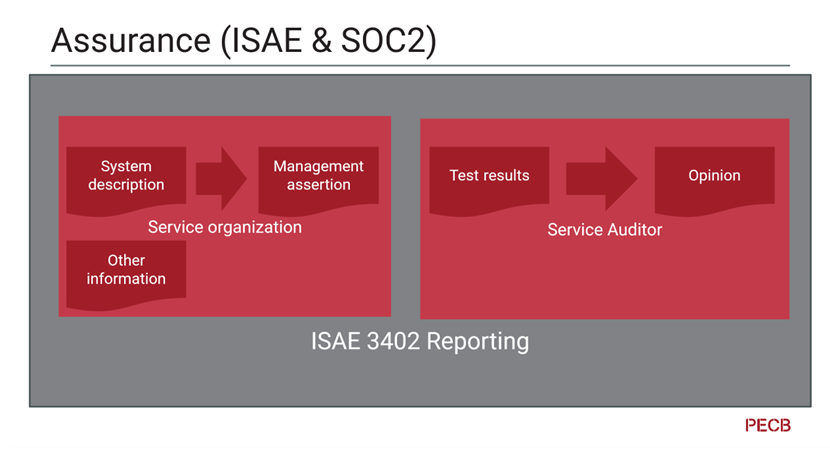
Their primary goal is to provide assurance about how services are delivered, often in relation to financial or operational processes. As explained in the presentation, ISAE 3000 serves as the general foundation, while ISAE 3402 adds more specific requirements for service organizations.
SOC 2 is American, governed by the American Institute of Certified Public Accountants (AICPA), follows a similar logic but is tailored to the needs of the US market. It focuses heavily on information security and trust, using the well-known Trust Service Criteria such as security, availability, confidentiality, processing integrity, and privacy.
What makes these frameworks fundamentally different from ISO 27001 is their perspective. Instead of asking, “Is your management system effective?”, they ask, “Are your services performing as expected for your customers?”
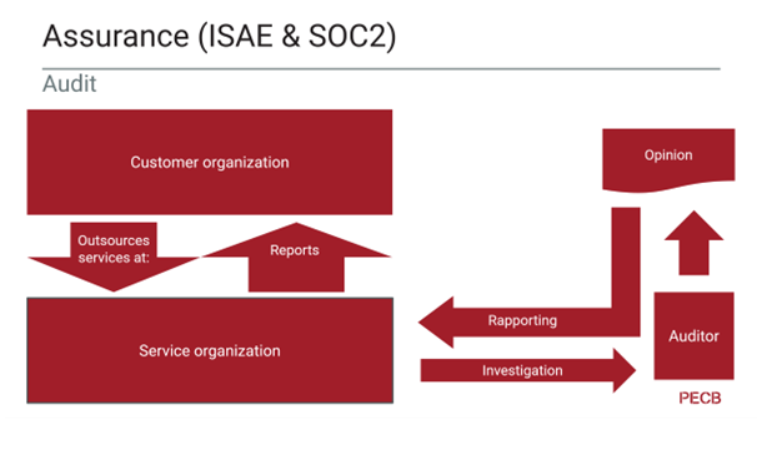
As illustrated in the slides below, assurance is not just about internal controls — it’s about proving to customers, through an independent auditor, that your services actually perform as expected.
The reality of audits: improvement vs observation
One of the most important — and often overlooked — differences lie in how audits are conducted.
ISO 27001 and the audits operate within a structured certification cycle. Organizations are audited over a three-year period,
- starting with an initial (full) audit,
- ongoing surveillance audits (year 1, year 2) and
- start the cycle with a recertification audit.
ISO 27001 has a strong emphasis on continual improvement. If issues are identified, there is an expectation that they will be addressed and resolved.
Assurance frameworks take a very different approach. Here, the auditor examines a defined period in the past, often between three (quarter) and twelve months (year). The goal is not to drive improvement, but to document what actually happened during that period. As illustrated in the comparison slides, this makes assurance audits inherently retrospective.
Peter summarizes it clearly: ISO 27001 is about moving forward, while SOC 2 and ISAE are about looking back.
This difference has practical consequences. Assurance audits require significantly more detailed evidence, as every statement must be supported by documented proof. At the same time, there is no formal mechanism forcing organizations to improve — the report simply reflects reality. And assurance audits are always in full scope.
Scope and focus: internal vs customer-driven
Another key distinction lies in what is actually being assessed.
ISO 27001 typically covers the entire organization or key activities when scoped to essential business services. It evaluates how information security is managed across all processes, departments, and systems. The result is a broad and holistic view of security.
In contrast, SOC 2 and ISAE are far more selective. Their scope is usually limited to specific external services that are relevant to customers. As a result, the focus is narrower but much deeper, concentrating on the areas that directly impact service delivery.
This customer-driven approach explains why many organizations do not adopt SOC 2 or ISAE voluntarily. Instead, these frameworks are often introduced as a requirement from clients, particularly in international or US markets.
Transparency and reporting
Perhaps one of the most striking differences between these frameworks is how results are communicated.
With ISO 27001, organizations receive a certificate that confirms compliance. While the certification is public, the detailed audit findings typically remain internal confidential.
Assurance frameworks take the opposite approach, details are published by default. The audit report itself becomes the primary deliverable and is shared with customers. It contains detailed descriptions of systems, controls, and test results, offering a high level of transparency.
As highlighted in the webinar, this transparency can be both a strength and a challenge. It builds trust with customers, but it also exposes weaknesses in a very visible way.
Cost and effort: a strategic consideration
The differences in approach naturally translate into differences in cost and effort.
ISO 27001 follows a predictable certification cycle, making it relatively manageable for most organizations. Assurance frameworks, however, require full audits on a yearly basis, combined with extensive evidence collection and documentation.
In practice, this means that SOC 2 and ISAE often come with significantly higher costs. As Peter points out, organizations must have a clear business case — typically driven by customer demand — to justify this investment.
When should you choose which?
In the end, the choice between these frameworks is not purely technical. It is strategic.
Organizations operating primarily in Europe, or those looking to build a solid security foundation, will often start with ISO 27001. It provides structure, flexibility, and a clear path for growth.
SOC 2 and ISAE, on the other hand, are typically driven by external requirements. Companies serving international clients, particularly in the United States, may find that these frameworks are not optional but essential.
As Peter puts it, ISO 27001 is usually an internal decision, while SOC 2 and ISAE are requirements explicitly made by your customers.
Due to their distinct nature, they can be combined, ISO 27001 is a good start, but it requires some extra work to extend the ISMS into SOC2 or ISAE success.
A final insight: ISO is just the start of the journey
One of the most important takeaways from the discussion is that ISO 27001, while powerful, is rarely the final step.
Because ultimately, when you run a business in the US or you have global customers, the question is not whether you will need assurance, but when.
Get ready for it.
References
The webinar is posted on PECB website here: https://pecb.com/en/past-webinars/iso-iec-27001-vs-soc-2-vs-isae-3000-choosing-the-right-assurance-path-for-your-organization
Video recording: ISO IEC 27001 vs SOC 2 vs ISAE 3000 Choosing the Right Assurance Path for Your Organization 1 – YouTube
Slide deck download:
https://pecb.com/wp-content/uploads/2026/04/PECB-Webinar-ISO-27001-vs-SOC2-vs-ISAE3000-V2.pdf
If you want to dive into more of these interesting PECB webinars, bookmark this link: https://pecb.com/en/past-webinars